Japanese Anime Companies in India 2026: Who Is Investing

In 2026, Japan’s anime and manga industry began doing more than selling to India. It started building a presence here.
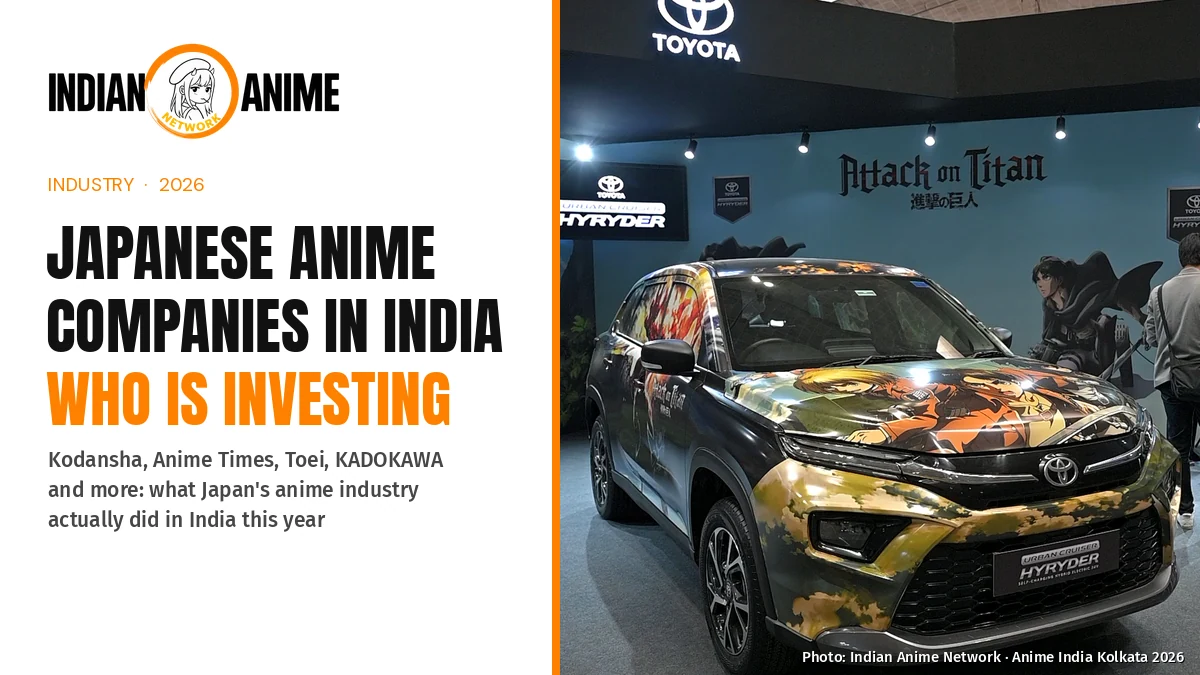
At Anime India Kolkata in February, Toyota showed an Attack on Titan-themed Hyryder, complete with anime-inspired artwork and a dedicated promotional display. Anime Times was there too, with a booth carrying its streaming brand across the convention floor [1]. We covered that weekend in our Inside Anime India Kolkata report.
It was a glimpse of a broader shift. Over the course of 2026, Japanese companies set up a publishing venture in Delhi, sponsored conventions across Indian cities, backed initiatives for Indian creators, and wrote India into their overseas expansion plans. Some of these moves are already running. Others are still announcements or long-term plans.
We looked at what Japanese anime companies, from manga publishers to streamers and studios, actually did in India this year, how firm each move is, and what it could mean for Indian fans, readers and creators.
The Numbers: Why India Became Hard to Ignore
In April 2026, Tokyo-based research firm GEM Partners published its Anime Global White Paper 2026, based on a survey of 15,000 people across 15 countries. In 2025, 41% of respondents in India said they watched anime. Only Japan (55%) and China (42%) recorded higher shares, and India was among the fastest-growing anime markets between 2020 and 2025 [2].
Then look at the box office. Demon Slayer: Infinity Castle earned about ₹70 crore in India, the highest reported total for any anime film in the country [3]. It wasn’t an isolated success. Doraemon: Castle of the Undersea Devil crossed ₹7 crore in 2026, placing it among India’s five highest-grossing anime films and ahead of Jujutsu Kaisen 0 [4].
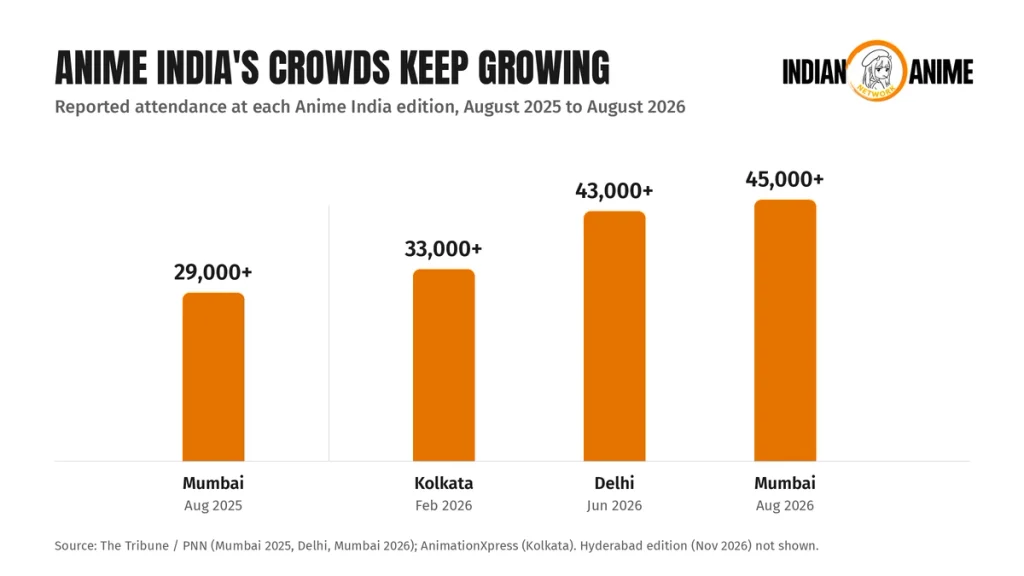
The audience is showing up outside cinemas, too. Anime India’s first edition, in Mumbai in August 2025, drew over 29,000 attendees [5]. In 2026, the convention went to Kolkata, Delhi and back to Mumbai, drawing over 33,000, 43,000 and 45,000 attendees respectively [1][6][7].
Streaming is another part of the picture. Crunchyroll’s Indian catalogue reportedly includes more than 850 anime titles, with over 130 available in Hindi, Tamil and Telugu dubs [8].
Market-size estimates for India vary widely depending on what they include, so none of these figures tells the whole story. Together, though, they point to a growing audience, bigger conventions and wider access, and in 2026 Japanese companies started responding with businesses, partnerships and initiatives on the ground.
Kodansha India: Printing Manga Here, in Hindi Too
The most consequential move of the year came from Kodansha, the Japanese publisher behind Attack on Titan and Blue Lock.
In June, Kodansha and Dai Nippon Printing announced Kodansha India, a joint venture based in Delhi. Kodansha holds 81%, Dai Nippon Printing 14%, and Delhi-based IJ Kakehashi Services the remaining 5%. The company was set up with ₹9.5 crore in capital and is headed by Hirotoshi Kurita, a Kodansha board director. Both companies describe it as the first time a major Japanese publisher has set up a local Indian subsidiary to publish printed books and manga [9][10].
Kodansha India plans to publish around 200 titles a year in print, in English and Hindi [11]. It officially launched at an event in Delhi in September [12], and on 28 September announced its first five titles: Attack on Titan, Blue Lock, Gachiakuta, Witch Hat Atelier and A Silent Voice [13]. That first lineup is in English only [14]. Prices and release dates have not yet been announced.
The reasoning is price and availability. Kodansha’s Yae Sahashi told Jiji Press that imported English-language volumes in India cost around ¥1,800 each, are hard to find, and push readers towards pirated copies. Kodansha’s stated answer is to release official editions at lower prices [15].
What a Manga Volume Costs in India Today
An imported English edition of Attack on Titan Vol. 1 carries a printed MRP of ₹1,050, and that is what it sells for at Storyteller Bookstore in Kolkata, one of the few stores in the city with a manga shelf all year. Online discounts can cut that sharply: on 26 November 2026, Amazon India listed the same paperback at ₹594, 43% below its MRP, with Penguin Random House India named as the importer [16]. In the US, the book’s list price is $10.99 [17].
Kodansha’s own estimate lines up with the shelf price. Using the exchange rate Anime News Network applied in a May 2026 report (¥1 million = ₹5,96,270), ¥1,800 works out to roughly ₹1,070, almost exactly the MRP printed on the book [18].
“Demand for manga in Kolkata has been tremendous,” says Mayura Misra, founder of Storyteller Bookstore, which has run manga pop-ups at Comic Con, Anime India and the Kolkata Book Fair. Our Comic Con Kolkata report has more on the city’s convention scene. On Kodansha India’s plan to print locally, she adds: “The cost will reduce once locally printed, and we are hoping that it will increase readership.”
The Groundwork Behind the Launch
Kodansha’s preparations started well before the announcement. In January 2026, the company ran a study tour to Delhi and Hyderabad, visiting studios, media firms, game developers, and the Indian offices of anime streaming companies. The tour was led by Yoshiaki Koga, who managed Kodansha’s India business for 15 years [11].
Koga’s work in India goes back further. He led the Japan–India project behind Suraj: The Rising Star, a remake of the classic baseball anime Kyojin no Hoshi (Star of the Giants) that swapped baseball for cricket [19][20]. Made by Kodansha and TMS Entertainment with India’s DQ Entertainment, it premiered on Colors TV on 23 December 2012 [21][22].
The demand Kodansha is now chasing was visible in Indian retail data years ago. In June 2021, IAN worked with Comic Clan to publish India’s ten trending manga, based on sales data the retailer shared with us. The unranked list included Jujutsu Kaisen, Demon Slayer, Chainsaw Man, Death Note and Haikyuu!!. Kodansha India is now trying to address that supply problem from the publishing side.
Anime Times: The Company Japan’s Rival Publishers Share
Kodansha, Shueisha and Shogakukan compete hard in Japan. In India, they share a company.
Anime Times Co. was founded in Tokyo in 2015 and is made up of 13 Japanese companies, including Avex Pictures, Kodansha, Shueisha and Shogakukan. In India, it runs the Anime Times channel on Prime Video, which launched on 12 December 2023. At the time of writing, the channel costs ₹399 a year, or ₹39 for the first month and ₹69 a month after that [23]. Our guide to where to watch anime in India covers the other legal options.
Its presence has grown well beyond streaming. Anime Times has supported Anime India since the convention’s first edition in Mumbai in 2025 [24]. In 2026, it co-presented the Kolkata edition with Toyota in February [1] and presented the Delhi edition in June [24]. For Mumbai in August, Anime Times and Toyota were title sponsors, and the two also presented the Hyderabad edition in November [23][25].
The Anime Idea Contest
Its most ambitious project is aimed at creators. The India x Japan Cross Culture Anime Idea Contest, run with Anime India, invited original anime ideas built on India–Japan cultural exchange; Anime Times gives its theme as “Cross Culture, Create Together”. The contest received 1,678 entry registrations. Actual submissions were 30 video entries (pilot videos and trailers) and 526 written proposals, from which 13 finalists were chosen [23].
View this post on Instagram
The best video entry was promised ¥1 million and distribution on Anime Times in Japan and India. The best written proposal was promised ¥300,000 [18][26].
The winners were named at Anime India Hyderabad on 14 November. Soumya won the video category with Kōya no Bōrei (荒野の亡霊), receiving her award from Bleach director Noriyuki Abe and the ¥1 million prize from Anime Times president Hideo Katsumata. Mansi Arun Utekar won the proposal category with Between Myth And You [27][28].
View this post on Instagram
View this post on Instagram
Anime Times says the longer-term aim is to pair Japanese production know-how with young Indian talent [23]. Whether any of these ideas move into development will be the real measure of the contest.
Studios, Toys and Comics: What Is Real and What Is a Plan
The rest of the year’s activity is harder to weigh. Some of it is strategy, some is reported but unconfirmed, and some is already running.
Toei Animation: India Is in the Plan
Toei Animation, the studio behind One Piece and Dragon Ball, set out its long-term overseas strategy, VISION2030, in late 2025. It plans to invest about ¥20 billion over five years in overseas anime production, and names India among the markets where it intends to develop projects that draw on regional cultures [29][30].
So far, though, Toei’s concrete overseas steps have been a studio in Vietnam and an office in Dubai, not a production base in India [31][32]. The studio has worked with overseas partners before, as with its Saudi co-production The Journey, but India has no equivalent yet.
India is in Toei’s plan. It is not yet on Toei’s map.
Bandai Namco: Made-in-India Merch, Reportedly
Bandai Namco India, the group’s Indian subsidiary set up in 2015, is reported to be exploring locally made anime merchandise, starting with apparel featuring One Piece, Dragon Ball and Naruto, along with India-exclusive designs and more stores in major cities [33]. The report relies on unnamed sources, and Bandai Namco has made no formal announcement, launch date, or pricing public.
If it happens, the point is price: locally made products could narrow the gap that pushes many fans towards cheaper unlicensed merchandise. For now, it remains a reported plan.
KADOKAWA: Publishing Indian Creators
KADOKAWA has taken a different route, focusing on creators rather than on selling an existing franchise.
In May 2026, the publisher began serialising Kung Fu Kung Fool on its manga portal KadoComi. The series is by masterlynx, brothers Jivan and Yash from Amravati, Maharashtra, who won a prize in KADOKAWA’s Wordless Manga Contest in 2025. KADOKAWA says it is the first commercial debut to come out of its programme supporting overseas creators [34][35], and the first collected volume of the Japanese edition went on sale on 6 November 2026 [36].
It is small next to Kodansha India, but it opens a different door: Indian creators entering Japanese manga publishing directly. For readers with the same ambition, our guide From Zero to Mangaka is a good place to start.
TV Asahi: Localising for Indian Children
TV Asahi’s relationship with India is older than any initiative in this piece. Doraemon has aired in India since 2005 and Crayon Shin-chan since 2006 [37].
In August 2025, TV Asahi went a step further with a remake of Obocchama-kun, co-produced with Hyderabad-based Green Gold Animation [37]. Rather than exporting an existing series, the project adapts a Japanese property for Indian children through an Indian studio, and it remains one of the clearest examples of that model.
What Japan Is Learning About India
Japan’s approach to India isn’t only about selling more anime or manga. Companies are also trying to understand what Indian audiences watch and what needs to change for Japanese content to work here.
JETRO, Japan’s trade agency, has been interviewing Indian studio heads for Japanese companies weighing the market. Green Gold Animation founder Rajiv Chilaka told it that Indians aged 18 to 34 lean towards Japanese anime and longer-form stories, and that dubbing quality still varies between Indian languages [38].
In the same report, JETRO suggests that Japanese firms localise beyond language, adapting to Indian food, humour and values; prioritise Hindi, then Tamil, Telugu and Bengali; and partner with Indian studios and schools [38]. For readers in Kolkata, Bengali being on that list is worth watching.
The audience also extends well beyond young adults. JETRO counts about 230 million Indians aged ten and under [37], which helps explain why Doraemon and Shin-chan still matter to Japanese companies, and why they keep looking for Indian studio partners.
What Changes for Fans in India
For Indian fans, what matters is less the announcements than what actually reaches them.
Possibly cheaper manga. Local printing removes some of the cost of importing single volumes. How much cheaper Kodansha India’s books are will only be clear when it sets its prices.
Manga in Hindi. A major Japanese publisher printing Hindi editions is new. Translation quality, price, and range will decide whether readers stay.
Legal digital manga. In October 2026, Crunchyroll, which is owned by Japan’s Sony Group, brought its manga service to India with more than 250 English titles; the service’s publishing partners include Kodansha and Shueisha. In India, it is available only through the Ultimate Fan membership, at ₹299 a month or ₹999 a year [39].
Conventions as a meeting point. With Japanese sponsors, visiting directors and creator contests, Indian conventions are becoming places where fans, creators and companies meet directly.
Local merchandise, maybe. Bandai Namco’s reported plans could make licensed products more affordable, but they remain unconfirmed.
None of this will happen overnight, and most of it is still concentrated in India’s biggest cities. Kolkata hosting the first stop of Anime India’s 2026 circuit was a start for the east.
Our View
For years, Japan’s anime and manga industry reached India from a distance, through licensing, streaming deals and imported books. In 2026, that began to change. Kodansha set up a publishing company here, Anime Times built a convention circuit and a contest around Indian creators, and KADOKAWA put an Indian duo’s manga into commercial serialisation in Japan.
Not every move carries the same weight, and some are still only plans. The publishing move matters most, because a volume on an Indian shelf at an Indian price changes who gets to read manga at all.
The test comes in 2027. Will manga become meaningfully cheaper? Will the Hindi editions be good enough to keep readers? Will Indian creators find lasting work in Japanese publishing and production? And will any of this reach beyond the biggest cities?
FAQs
Is Kodansha publishing manga in India?
Yes. Kodansha set up Kodansha India in Delhi in 2026 and plans to publish around 200 titles a year in English and Hindi. Its first lineup, in English, includes Attack on Titan, Blue Lock, Gachiakuta, Witch Hat Atelier and A Silent Voice.
Will manga become cheaper in India?
That is the aim. Kodansha says it wants to sell official editions for less than today’s imports, which carry an MRP of around ₹1,050 for a single volume. The real difference will only be clear once Kodansha India announces its prices.
Which Japanese anime companies are active in India?
Kodansha (through Kodansha India), Anime Times, KADOKAWA, and TV Asahi all have projects running in India. Toei Animation has named India in its overseas plan, Bandai Namco India is reported to be planning local merchandise, and Sony-owned Crunchyroll streams anime and now offers digital manga here.
How popular is anime in India?
Very. GEM Partners’ Anime Global White Paper 2026 found that 41% of people surveyed in India watched anime in 2025, the third-highest share of the 15 countries surveyed, after Japan and China.
Sources
- [1] AnimationXpress, Anime India Kolkata 2026 (attendance, Toyota and Anime Times).
- [2] GEM Partners, Anime Global White Paper 2026, 16 April 2026.
- [3] Outlook Respawn, Demon Slayer: Infinity Castle returns to Indian theatres.
- [4] NewsBytes, Doraemon box office in India, 5 October 2026.
- [5] The Tribune / PNN, Anime India 2025 records over 29,000 footfall.
- [6] The Tribune / PNN, Anime India Delhi 2026, 12 June 2026.
- [7] The Tribune / PNN, Anime India Mumbai 2026 draws over 45,000 fans.
- [8] Indian Television, Crunchyroll India library.
- [9] Dai Nippon Printing, Kodansha India joint venture announcement, June 2026.
- [10] Oricon, Kodansha to launch publishing joint venture in India.
- [11] AdverTimes (Japanese), Japanese IP companies and India, 24 June 2026.
- [12] Indian Television, Kodansha India officially launches in Delhi.
- [13] Anime News Network, Kodansha India announces 5 manga titles, 28 September 2026.
- [14] libro on note (Japanese), quoting Kodansha’s announcement of Kodansha India’s first English lineup.
- [15] Jiji Press via Nippon.com, Japanese manga publisher to enter Indian market, 12 July 2026.
- [16] Amazon India, Attack on Titan Vol. 1 paperback listing, checked 26 November 2026.
- [17] Kodansha USA, Attack on Titan Vol. 1.
- [18] Anime News Network, Anime Times and Anime India launch Anime Idea Contest, 31 May 2026 (prize amounts and rupee conversion).
- [19] JICA (Japanese), presentation by Yoshiaki Koga.
- [20] Jaipur BookMark, speaker profile: Yoshiaki Koga.
- [21] The Japan Times, Cricket remake of popular baseball anime to hit Indian TV, 6 December 2012.
- [22] Embassy of Japan in India, launching reception for Suraj – The Rising Star, 4 December 2012.
- [23] Anime Times release via Anime!Anime! (Japanese), 11 September 2026.
- [24] Indian Television, Anime Times to present Anime India Delhi 2026.
- [25] AnimationXpress, Bleach director Noriyuki Abe to meet fans as Anime India arrives in Hyderabad.
- [26] Anime Times, India x Japan Cross Culture Anime Idea Contest (official page).
- [27] Anime India and Anime Times India, official contest announcements on Instagram. Winners, 14 November 2026: Proposal category | Video category. Finalists and entry titles, 4 September 2026: Finalists post.
- [28] Soumya, winner’s Instagram post documenting the award, 22 November 2026.
- [29] Endless Mode, Toei Animation’s plans for overseas markets (VISION2030).
- [30] Outlook Respawn, Toei Animation targets India as key market, 4 November 2025.
- [31] KAI-YOU (Japanese), Toei’s Vietnam studio and Dubai office, May 2026.
- [32] Automaton, Toei Animation to establish new studio in Vietnam; Dubai office in preparation.
- [33] Outlook Respawn, Bandai Namco made-in-India anime merchandise, 12 May 2026.
- [34] KADOKAWA, India-based winner of international manga contest makes professional debut in Japan, 15 May 2026.
- [35] Anime News Network, Indian manga duo launches Kung Fu Kung Fool manga on May 15.
- [36] KADOKAWA release via PR TIMES / Game*Spark (Japanese), Kung Fu Kung Fool Vol. 1 on sale 6 November 2026.
- [37] JETRO (Japanese), TV Asahi’s anime strategy in India, 10 December 2025.
- [38] JETRO (Japanese), India’s entertainment market: animation, 21 January 2026.
- [39] Outlook Respawn, Crunchyroll Manga launches in India with 250+ titles, 9 October 2026.