Why a Fictional Flag has become a Phenomenal Expression of Revolt against Institutionalized Power & Oppression

“No matter how hard or impossible it is, never lose sight of your goal.”
These words were said by a Pirate leader, not in real life but by a fictional pirate. However, based on recent real-life incidents, these words & spirit of the same rebellion have come to life in this day & age, offering a timeless philosophy of defiance and unwavering perseverance toward a vision despite obstacles, portraying an Anti-Establishment Ethos.
This spirit of rebellion and relentless pursuit has seen a profound modern resurgence. The commitment to seemingly insurmountable objectives now serves as a rallying cry, evident across real-world events. From grassroots social justice movements challenging power to innovators pursuing technological breakthroughs, the core message—to hold fast to ambition despite perceived impossibility—is a vital, actionable directive for progress.
The following recent incidents illustrate how this unwavering pirate spirit has erupted among protesters worldwide
The Indonesian “Emergency Alert” Protests (August 2025)
This is arguably the epicenter of the flag’s current political momentum. Ahead of Indonesia’s 80th Independence Day, widespread protests erupted against the government of President Prabowo Subianto. The trigger was a perceived attempt to bypass a constitutional court ruling to consolidate power.
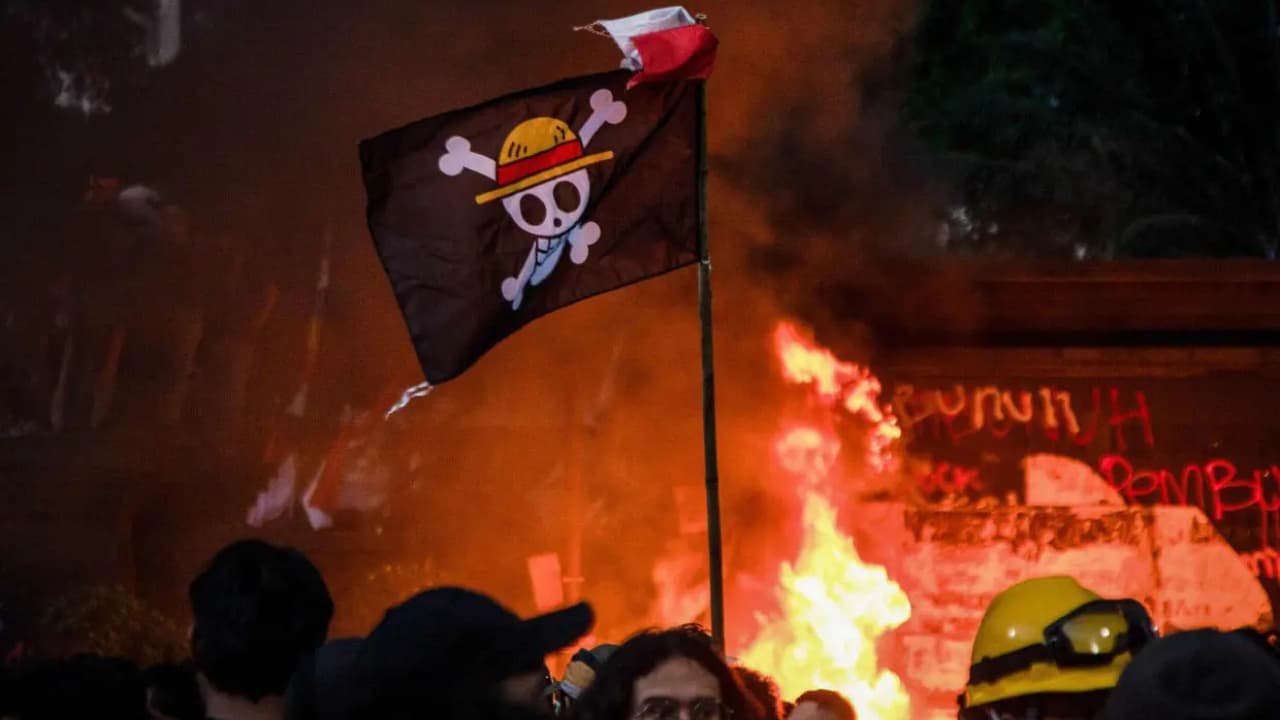
Instead of flying the national “Red and White” flag as requested by the President, hundreds of thousands of protesters, including truck drivers, students, and activists, hoisted the Straw Hat Jolly Roger flag as a silent protest against the “draconian regime.”…ultimately resulted in authorities arresting over 3,000 people nationwide during this period.
Government officials went as far as deeming deploy of the Jolly Roger flag as a criminal activity through various legal stipulations threatening “Criminal consequences” and labeled the flag as “Performative Patriotism” & “Coordinated attempt to divide the nation” an eventual symbol of treason issuing warnings that individuals found in violation of the law regarding the desecration or degradation of the national flag could face severe penalties, including criminal prosecution. A maximum prison sentence of five years & fine of up to 500 million Indonesian Rupiah (approximately $31,000 USD).
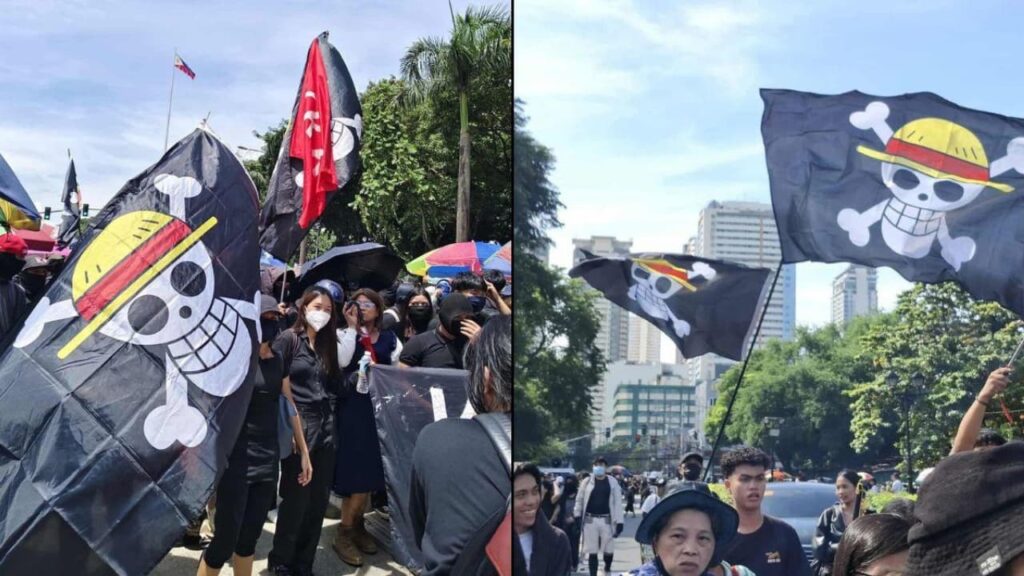
The government’s statements quickly backfired, as the flag rapidly transformed into a representation of “Dark Indonesia”—a counterpoint to the official “Golden Indonesia” slogan. This new symbolism embodied a direct refusal to recognize a regime perceived as corrupt and driven by dynastic interests.
The prominent resemblance of Donquixote Doflamingo: Ruler of the kingdom, not just through brute force, but through manipulation. He uses his power to control the King and the army like puppets, making them attack their own people against their will. A central grievance of the protests was the perception of a “Shadow Ruler” or “Puppet Master.”
Critics argued that outgoing President Jokowi was maneuvering behind the scenes (like Doflamingo) to alter laws and the constitution to install his son (Kaesang) into power, effectively treating the Parliament and the Courts as puppets to secure a political dynasty.
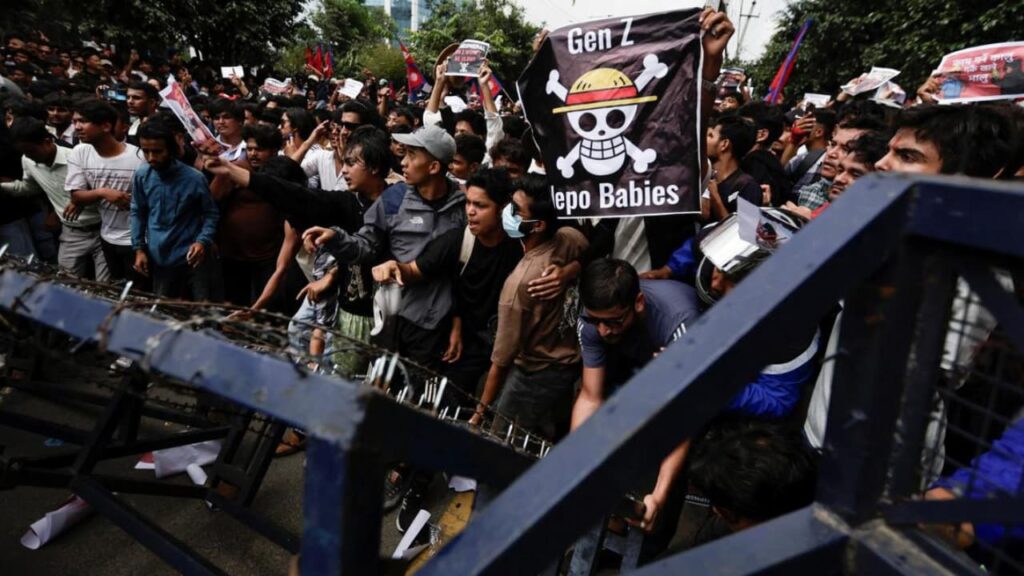
The “Gen Z” Uprising in Nepal (September 2025)
Following the momentum in Southeast Asia, the symbol crossed into South Asia during a volatile period in Kathmandu.
Youth-led protests broke out in mid-September against the government’s ban on certain social media platforms and allegations of deep-seated corruption among the political elite.
“The leaders’ children return from abroad with Gucci bags; while the people’s children return in coffins.”
Weeks before the physical protests, a massive campaign exploded on TikTok and Instagram under hashtags like #NepoKid and #NepoBabies. In the following weeks, the government (led by Prime Minister K.P. Sharma Oli) proceeded to ban 26 social media platforms, including TikTok, Facebook, and WhatsApp, citing “national dignity” and “regulatory compliance.”
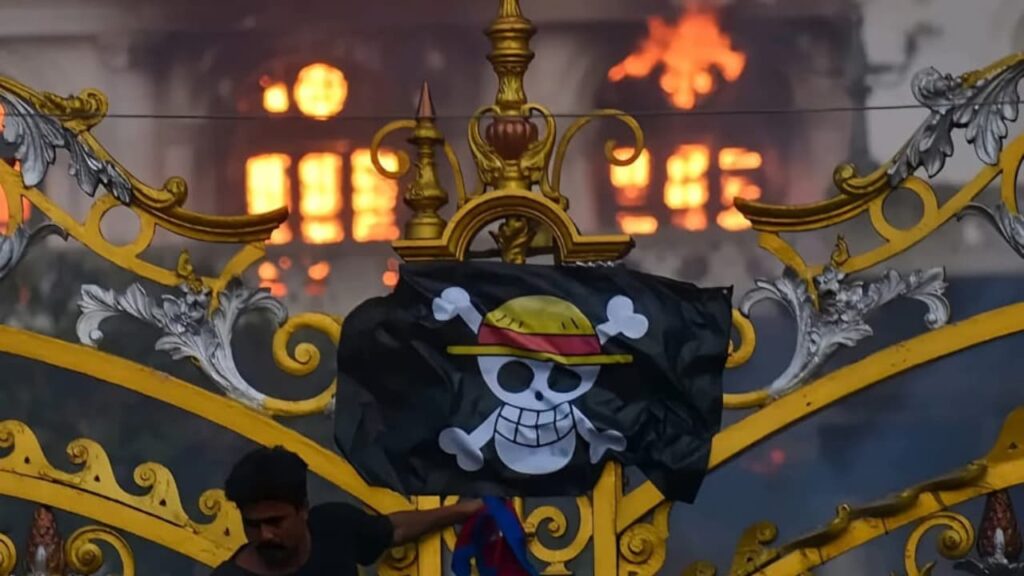
In this uprising, nepotism was not just a side issue; it was the primary lens through which Gen Z viewed the state. They framed the conflict as a battle between “The Children of the Struggle” (ordinary youth) and “The Children of the System” (the nepo kids). One Piece flag, in this context, represented the “pirates” coming to dismantle a rigged system that only served the “World Nobles” (the political elite).
The striking similarity between the Nepal uprising and the Alabasta Arc lies in the weaponization of information by a ruling power to mask deep-seated corruption. Just as Sir Crocodile portrayed himself as a national hero while secretly using “Dance Powder” to engineer a drought and frame King Cobra, the Nepali government attempted to frame their social media ban as a protective measure for “national dignity” while actually using it to shield the “Nepo Kids” and political elite from scrutiny.
In both narratives, the conflict was not a simple rebellion but a tragedy of betrayal, where the Rebel Army (in Alabasta) and Gen Z (in Nepal) were ordinary citizens forced to storm their own capital because the institutions designed to protect them had been hijacked by actors who were draining the country’s resources for their own gain.
The “Satroka” Movement & The “Empty Bucket” March in Madagascar (September–October 2025)
The movement was sparked by the complete failure of JIRAMA, the state-owned water and electricity utility. By September 2025, the capital city of Antananarivo and surrounding regions were facing “blackout weeks”—periods with no electricity for 18 hours a day and taps running completely dry.
The government blamed “climate change,” but investigative reports leaked on social media revealed that funds meant for new turbines and water pumps had been siphoned off by officials for private villas.
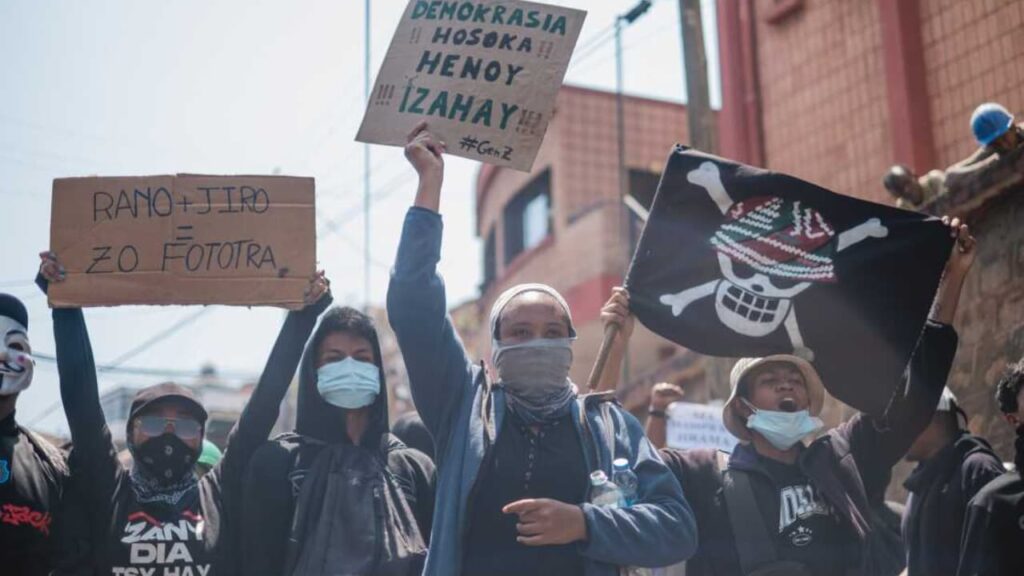
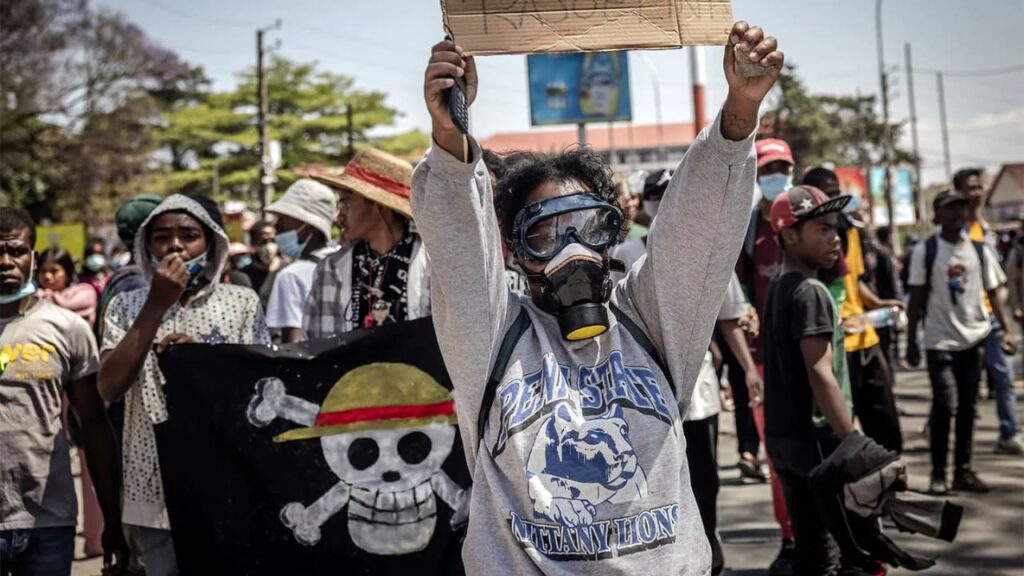
The Satroka replaced Luffy’s signature yellow straw hat with a “Satroka Bozaka”, the traditional wide-brimmed Malagasy straw hat worn by farmers and ancestral elders. This transformed the symbol from “Pirate King” to “Guardian of the Land,” signaling that the youth were not just anime fans but the true inheritors of the country’s struggle against colonization—this time, against a colonizer from within.
Thousands of students and mothers marched toward the Presidential Palace carrying empty yellow water jerrycans while painting the One Piece skull-and-crossbones directly onto these yellow plastic cans.
The protesters chanted “We want the Blue Sea, not the Red Line,” a clever double entendre referring to the One Piece ocean geography and the “Red Line” of government bureaucracy blocking their water.
These Movements strongly mirror the Wano Country Arc, as similar parallels can be drawn sincerely, while in Wano, the tyrant Kaido and the Shogun Orochi control the only clean food and water, leaving the citizens to drink toxic leftovers. In Madagascar, the wealthy elites had private generators and water deliveries, while the poor farmers had nothing. The “Satroka” protesters were essentially the “Samurai” demanding the return of the country’s natural resources to the people.
In conclusion, it can be said that the Madagascar protest was essentially Alabasta come to life, a population realizing that their “drought” was not an act of God, but an act of greed, and marching on the capital to force the “rain” (governance/resources) to return.
The “Ghost Projects” March in the Philippines (September 2025)
In early September 2025, a super typhoon (locally named Karding II) submerged large parts of Metro Manila and the rice-growing provinces of Bulacan and Pampanga. The government had claimed that billions of pesos in “Confidential Funds” and flood control master plans had been spent over the last 3 years to prevent this exact scenario.
When the waters rose, the floodgates didn’t work, the pumping stations were missing parts, and entire dikes listed in government reports simply did not exist. They were “Ghost Projects”—paid for on paper, but invisible in reality.
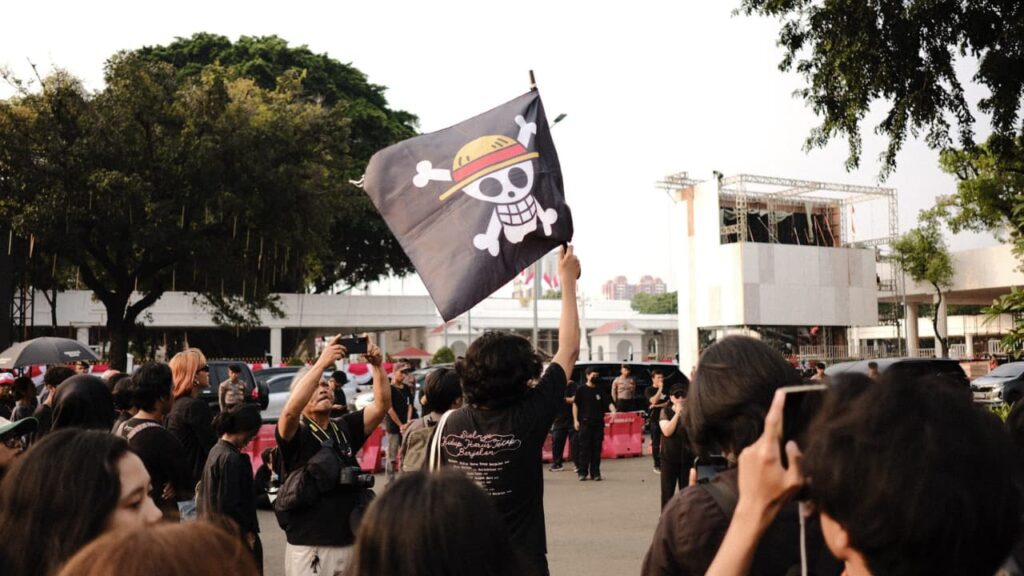
Traditionally, pirates are described as looting thieves. However, the protesters argued that the politicians were the true pirates, having looted the national treasury.
“Magnanakaw sa Gobyerno, Tulisan sa Palasyo”
(Thieves in the Government, Bandits in the Palace).
Protesters wore life vests and inflated rubber boats to march on dry land, mocking the government’s lack of flood preparation. In a befitting sarcastic overtone, protesters flew the Straw Hat Jolly Roger to signal that they (the “pirates”) had more honor than the “Marines” (the government/police) protecting the thieves.
In observing this story, the Philippine protests bear a striking resemblance to Luffy’s childhood arc in the Goa Kingdom, specifically the Gray Terminal. The “Ghost Projects” mirrored the High Town’s walls: funds designated for aiding the impoverished were illicitly diverted to finance the extravagant lifestyles of politicians (luxury cars, mansions), effectively constructing a “High Town” and abandoning the “Gray Terminal” (the flood-vulnerable slums) to the risk of being submerged.
In conclusion, we can say the immense symbolic power of Eiichiro Oda‘s One Piece flag stems directly from the manga and anime’s storyline. It functions as a potent banner of freedom and rebellion, deeply resonating with real-world struggles against corruption and oppression by serving as a visual protest against the oppressive and corrupt World Government.
The crew’s adventures frequently involve liberating oppressed people and directly challenging tyrannical figures and corrupt systems. Protesters, especially those from Modern Generation, have adopted the flag as a visual shorthand to express discontent with their own corrupt or authoritarian governments.
The global popularity of One Piece provides a ready-made, instantly recognizable symbol that transcends language and geography. It acts as a powerful sign of solidarity among young activists in different countries facing similar issues of injustice.
Using a cartoon pirate flag is a playful yet subversive act. It is a way to communicate a bold political message in a creative and non-confrontational manner, which can be harder for authorities to police or dismiss than traditional protest signs.
The spirit of the Straw Hat crew—optimism, resilience, a fight for friends, and an unwillingness to bow to power—aligns perfectly with the ideals of a youthful movement demanding a better world.