When a Story Becomes Too Loud to Wear

Some images are powerful precisely because they do not travel well.
They belong where they were born—inside a frame, on a wall, in the sealed logic of a story. When removed from that context, they do not lose beauty, but they gain weight. Too much of it.
This is often mistaken for scale or boldness. It is something else entirely.
A story can be visually striking, emotionally exact, and still feel unbearable when brought close to the body. Not because it is flawed, but because it is complete. It already knows where it belongs.
There is a difference between an image that wants to be worn and one that wants to remain intact.
Anime is full of the latter.
Certain moments carry an emotional density that resists translation. They are charged with culmination—grief that has no aftermath, violence that resolves nothing, declarations that close a door rather than open one. On screen, these moments feel necessary. They complete something.
Off-screen, they do not soften.
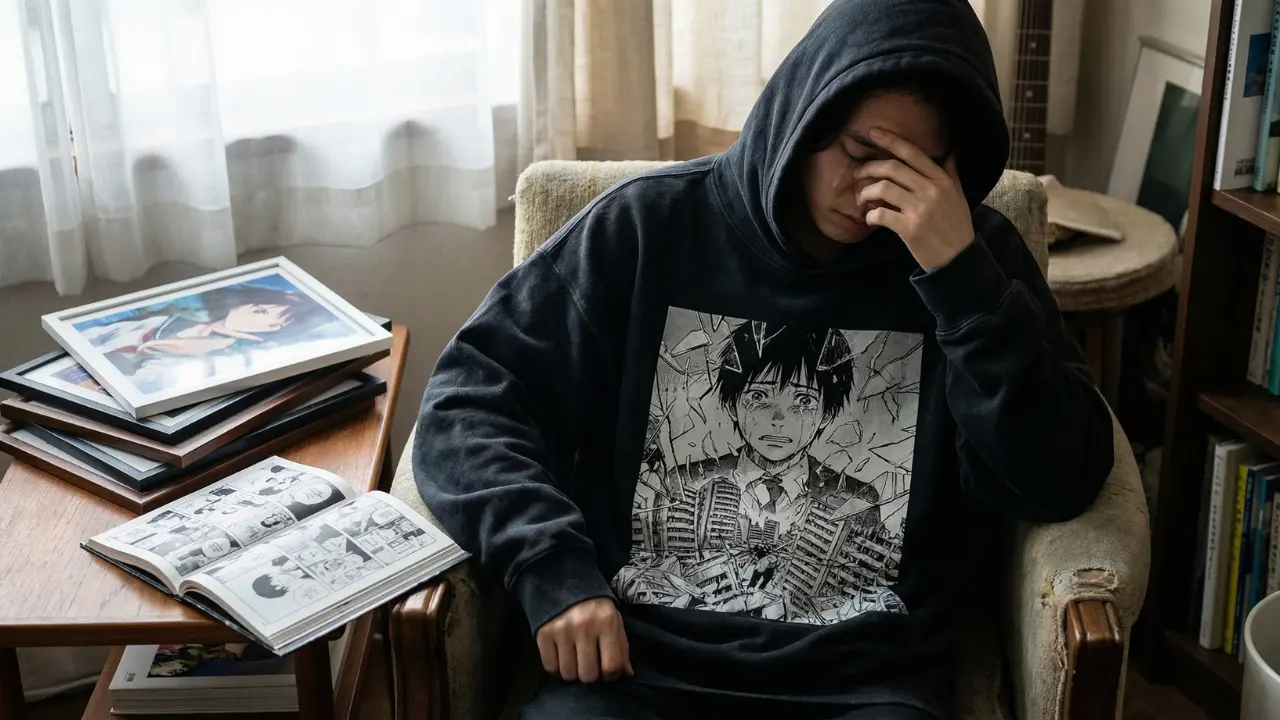
To wear such an image is to ask it to perform continuously. To carry its intensity into ordinary time. To let it speak even when the wearer is silent. This is where loudness begins—not in volume, but in persistence.
Clothing does not have the luxury of containment.
Unlike a frame or a page, it moves through the day. It enters rooms, passes strangers, accumulates context. Whatever it carries, it carries publicly, repeatedly, without pause.
Some stories are not built for that kind of exposure.
They demand attention in a way that clothing cannot ethically sustain. They insist on being seen as moments, not as surfaces. When transferred without restraint, they do not become expressive—they become intrusive.
This is the threshold where a story stops being wearable.
Not because it is too much.
But because it has already said everything it needed to say.
Intensity and Survivability
Intensity is often mistaken for depth.
In visual culture, the most striking images tend to dominate conversation. They are remembered, repeated, extracted. Their power is immediate. Their impact is undeniable. It feels natural to want to carry them forward—to let them live beyond their original moment.
But intensity is not designed for longevity.
Stories reach intensity at points of compression. Everything converges: emotion, consequence, meaning. The image becomes dense because it holds an ending, or a rupture, or a truth that cannot be extended without distortion. Its force comes from finality.
Clothing operates on the opposite principle.
It survives by repetition. It must endure boredom, habit, misinterpretation. It moves through hours that are not emotionally charged. It accompanies the body when nothing significant is happening. Whatever it carries must be able to coexist with ordinary time.
This is where the problem emerges.
An image that demands constant recognition exhausts itself when worn. Its meaning does not deepen through repetition; it flattens. The intensity that once felt precise becomes noise—not because the image was weak, but because it was never meant to persist.
Anime understands this distinction instinctively.
Its most powerful moments are often brief. They arrive, land, and withdraw. They are allowed to remain unextended. To force them into permanence would be to misunderstand their function.
When such moments are translated without reduction—without restraint—they overwhelm the object meant to carry them. The result is not expression, but burden.
The story becomes too loud because it refuses to quiet itself.
Survivability, then, is not about dilution. It is about adaptability.
A narrative that can be worn must be able to lose something without losing itself. It must tolerate ambiguity, partial reference, distance from its origin. It must survive being encountered out of order, without explanation.
Not all stories want this.
Some insist on their full context. They require buildup, aftermath, silence around them. They cannot be fragmented and remain honest. When placed onto a surface that moves through daily life, they protest—not audibly, but through discomfort.
The wearer feels it before they can articulate it.
The image draws attention when attention is unwelcome. It speaks when the body wants to remain neutral. It replays a moment that was meant to occur once.
This is not a failure of design.
It is a mismatch of intention.
Intensity completes a story.
Survivability allows it to live on.
When the two are confused, loudness follows.
And loudness, unlike intensity, does not resolve.
What Translation Removes
When a story moves from one form to another, something is always lost. This is not a flaw. It is the condition of translation.
What matters is what is removed—and why.
Anime narratives are built with an understanding of enclosure. They unfold within frames, episodes, arcs. They control duration. They decide when intensity appears and when it is allowed to dissolve. Silence is placed deliberately around meaning.
When a story leaves that enclosure, it loses its ability to manage time.
Clothing does not choose its moments. It is present continuously. It does not know when to pause or when to retreat. Whatever is placed upon it must accept this exposure.
This is why translation demands restraint.
To translate a story honestly is not to preserve everything. It is to identify what cannot survive movement—and to let it go. The climax. The scream. The final look that closes a chapter. These are not details; they are endings. They resist portability.
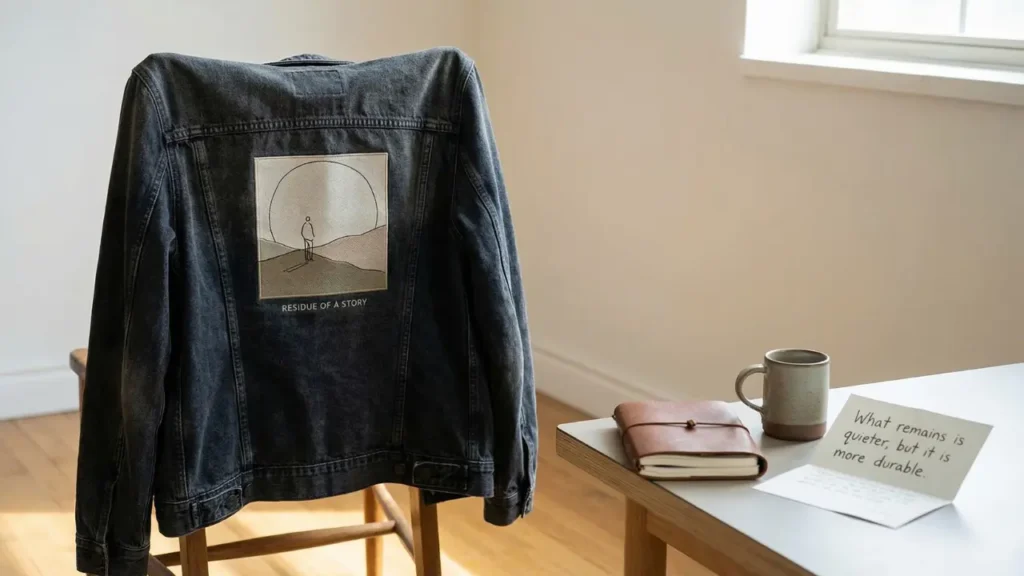
What remains, if the translation is careful, is not the story itself but its residue.
A tone.
A posture.
A fragment of atmosphere.
This residue is quieter, but it is more durable. It does not insist on recognition. It does not demand interpretation. It can exist alongside other meanings without collapsing them.
This is the difference between reference and presence.
Reference points back loudly: remember this moment.
Presence allows the story to be felt without being named.
Anime, when approached with this sensitivity, offers an abundance of such residues. Not its most dramatic scenes, but its intervals. The moments between decisions. The visual habits that persist long after the plot has moved on.
These are the elements that can survive translation.
They do not carry the full weight of the story. They do not need to. They carry its temperature.
When translation refuses to remove, to edit, to reduce, to quiet—it mistakes fidelity for completeness. The result feels impressive, but it does not endure. The story remains intact, but the object collapses under it.
To make something wearable is not to honor everything.
It is to choose carefully what is allowed to remain.
This choice is not aesthetic.
It is ethical.
Quietness as Respect
There is a particular discipline in allowing something to remain quiet.
Not because it lacks power, but because its power does not need repetition to stay intact. Some stories are strongest when they are encountered once, fully, and then allowed to recede into memory. They do not ask to be carried forward. They ask to be remembered accurately.
To insist on their presence everywhere—to make them visible at all times—is to misunderstand what they offered in the first place.
Quietness, in this sense, is not absence. It is restraint guided by care.
When a story becomes too loud to wear, it is often because the translation has refused to acknowledge an ending. It keeps the moment alive beyond its natural life span. It turns culmination into background noise. What was once precise becomes diffuse.
Letting a story stay quiet is a way of honoring its limits.
Anime understands this intuitively. Many of its most resonant images are not designed to travel. They are framed to arrive, to do their work, and to withdraw. Their meaning is bound to time—to the duration of a scene, the length of a pause, the space that follows.
When those images are allowed to remain where they belong, they retain their dignity. When they are forced into permanence, they lose it.
Wearability is not a measure of importance.
Silence is not a sign of weakness.
Some stories ask to be lived with.
Others ask to be left intact.
Recognizing the difference is an act of respect—toward the story, and toward the body that would otherwise have to carry it.
Not everything meaningful needs to stay close.
Some meanings are preserved best by distance.
And in that distance, they remain what they were meant to be—complete, undistorted, and quietly whole.