
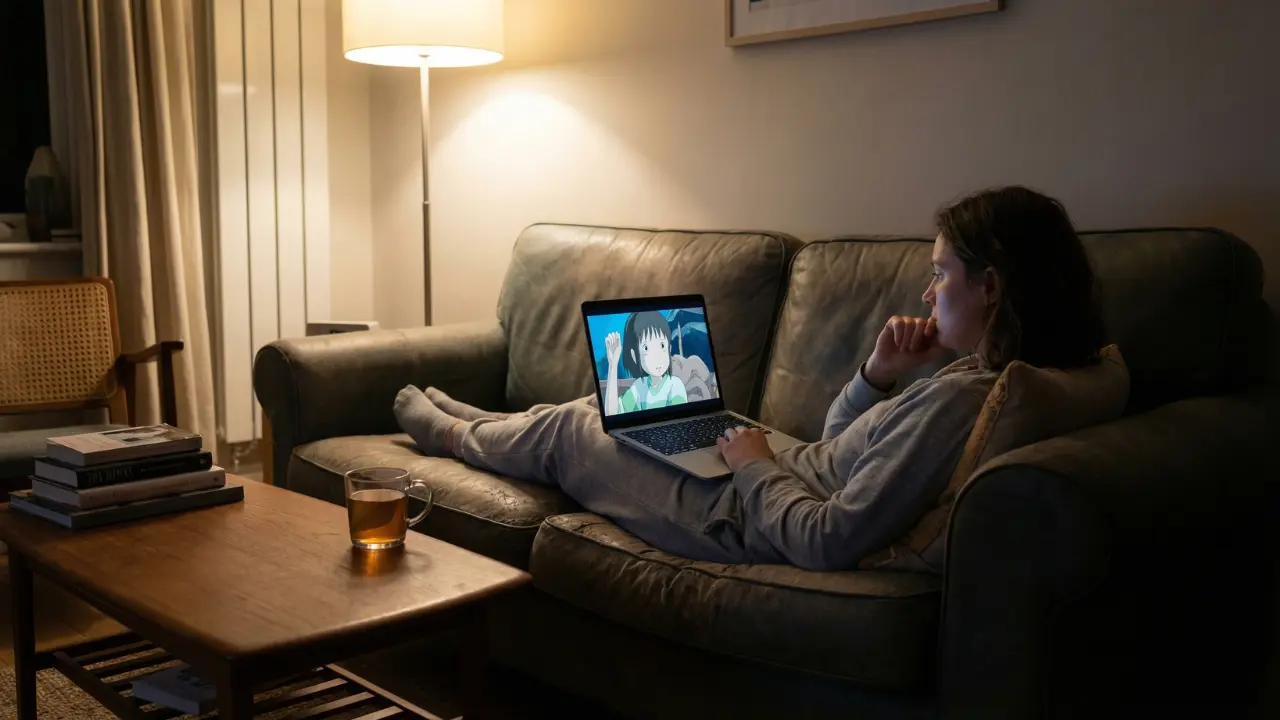
Watching Anime Alone, On Purpose

There is a particular quiet that arrives when you decide to watch something alone—not because no one else is around, but because you have chosen not to invite them in.
The room does not change. The screen does not change. What changes is the direction of attention. It turns inward, settles, becomes less performative. You are no longer watching with the possibility of being seen watching.
This kind of solitude feels different from isolation. It is deliberate. Protective. Almost careful.
When you watch alone, there is no second consciousness in the room to lean toward. No glance exchanged during a pause. No small shift of posture to check whether a moment landed. The work is allowed to arrive without witnesses. Your reactions are unmonitored. They do not need to be timed, softened, or shared.
This is especially true with anime.
Anime often asks for a kind of attention that feels easily disrupted. Its silences stretch. Its emotions arrive without announcement. Its most important moments are rarely the loud ones. To experience this fully, the viewer has to remain still long enough for meaning to accumulate.
Watching alone makes that possible.
Not because solitude is purer, but because it is quieter.
In company, attention fractures subtly. Even when the room is silent, part of the mind remains alert to the presence of the other—to their breathing, their reactions, their interpretation forming alongside yours. The act of watching becomes slightly external. You begin to watch yourself watching.
Alone, that loop collapses.
There is only the screen, and the slow negotiation between what it offers and what you are willing to receive. No one to impress. No one to reassure. No one to translate the moment into conversation before it has finished becoming itself.
This is not a rejection of shared experience. It is a postponement of it.
Some encounters need privacy first.
Watching anime alone, on purpose, is not about preference or personality. It is about respect—both for the work and for the fragile, unrepeatable moment of first contact.
Attention Is Not Endless
Attention is often treated as something we either have or don’t. In practice, it behaves more like a reserve—finite, sensitive, easily diluted.
First encounters draw deeply from it.
When we watch something for the first time, especially something layered and emotionally restrained, attention is doing several kinds of work at once. It is tracking narrative, calibrating tone, learning rhythm. It is adjusting to a new visual language, a new pace of silence, a new way of withholding information. Nothing is yet familiar enough to be automatic.
Anime frequently intensifies this demand. It asks the viewer to notice what is not emphasized. To stay with moments that feel unresolved. To allow meaning to form slowly rather than arrive packaged. This kind of watching is effortful, but not in an exhausting way. It requires steadiness.
Solitude helps preserve that steadiness.
When another person is present, even silently, a portion of attention shifts outward. It becomes divided—part of it monitoring the shared space, part of it remaining with the screen. The shift is subtle, often unconscious, but it changes the texture of the experience. Attention thins.
This is not a failure of connection. It is a property of it.
To share a space is to share awareness. The mind accounts for the other, even when it does not intend to. This is why watching with someone else often feels lighter, faster, more conversational. Attention moves quickly because it is no longer required to hold everything alone.
But first viewings ask to be held.
Watching alone allows attention to remain undiluted. It creates a sealed environment in which the work can establish itself without competition. The viewer does not need to decide when to react or whether a reaction is appropriate. There is no ambient expectation to translate feeling into response.
The experience remains internal.
This internality matters. It is where initial impressions take shape before they are named. Where confusion is allowed to stay confusing. Where discomfort is not immediately smoothed over by commentary. Watching alone gives attention the time it needs to arrange itself.
Only after this arrangement does sharing become meaningful.
To watch alone, on purpose, is to acknowledge that attention is not infinite—and that some encounters deserve to draw from it fully, without interruption.
It is not about intensity.
It is about preservation.
The Subtle Distraction of Company
Watching with someone else changes very little on the surface. The screen is the same. The story unfolds at the same pace. The dialogue does not pause to acknowledge the extra presence in the room.
And yet, something fundamental shifts.
Attention, once inward, begins to lean outward. Not dramatically—almost politely. A small part of the mind remains aware of the other person’s posture, their breathing, the moment they laugh or stay silent. Even without conversation, a second rhythm enters the room.
You begin to feel moments alongside someone rather than inside them.
This is not a failure of focus. It is a natural adjustment. Human awareness is relational. When another person is present, attention expands to include them, even when we do not intend it to. The viewing experience becomes shared space rather than sealed encounter.
What is lost is not intensity, but privacy.
In company, reactions arrive sooner. A glance during a pause. A smile exchanged when a scene lands. A quiet anticipation of how the other person will receive what you are receiving. The mind prepares to translate experience into something readable.
Anime, especially when restrained, resists this translation.
Its silences are not cues. Its emotional shifts often arrive without warning. To experience them fully requires a kind of inward suspension—a willingness to stay with a feeling before deciding what it means. In shared viewing, that suspension shortens. Interpretation begins earlier. Experience moves toward commentary.
You are no longer only watching the work.
You are also watching the effect it has.
This does not make shared viewing shallow. It makes it social.
But first encounters often ask for something else.
They ask for the freedom to misunderstand. To miss things. To sit with reactions that do not yet have language. To feel without immediately positioning that feeling in relation to another person’s response.
When watching alone, there is no need to check whether a moment was “supposed” to matter. No subtle pressure to align. No impulse to soften discomfort or heighten enthusiasm. The experience remains unmeasured.
This unmeasured space is fragile. Once attention bends outward, it is difficult to recover fully. The moment has already been witnessed. The silence has already been shared.
Which is why, for many viewers, the first encounter feels instinctively solitary.
Not because others would ruin it—but because some relationships need to form before they can be observed.
Good. Then we keep the pressure exactly where it is—low, steady, honest.
What comes next is not escalation.
It’s resolution without closure.

Rewatching, and the Permission to Invite Others In
There is a difference between encountering something and returning to it.
The first time, the work asks for privacy.
The second time, it allows for company.
Rewatching changes the balance of attention. The story no longer requires full orientation. The rhythm is familiar. The silences have already been felt once, without witnesses. Meaning has settled enough to be shared without risk of dilution.
Only then does watching with someone else feel natural.
On a rewatch, attention loosens. There is room to notice another person again—to observe their reactions without losing your own. The work no longer competes for all of your awareness. It has already claimed its place.
Sharing becomes possible because discovery is no longer at stake.
This is why rewatching with someone you care about often feels more generous than watching together for the first time. You are not guarding the experience anymore. You are offering it. Not as something fragile, but as something you know.
In this context, company does not distract. It deepens.
You watch them meet the moments that once met you. You notice where their attention lingers, where it drifts, where it sharpens. The work becomes a medium for connection rather than a demand upon it.
The solitude of the first viewing makes this possible. It establishes a private relationship that can later tolerate observation. Without that initial privacy, the experience risks being shaped too early by shared interpretation.
Rewatching, then, is not repetition.
It is translation.
What was once internal becomes shareable—not because it has lost intensity, but because it no longer needs protection.
This is not a rule. It is a rhythm.
Some stories invite company immediately. Others insist on being met alone. Anime, with its particular reliance on silence and restraint, often belongs to the latter.
To watch alone first is not to exclude others.
It is to prepare something worth sharing.
Afterward: Watching Less, Watching Truer
There comes a point when watching changes—not suddenly, not decisively, but quietly.
What once felt urgent begins to feel optional. The impulse to finish something in one sitting softens. Episodes stretch apart. Gaps appear between viewings, not because interest has faded, but because attention has learned its own limits.
This is often described as growing out of something. It feels more accurate to call it settling into something else.
Watching less does not mean caring less. It often means caring differently.
Anime, encountered this way, stops functioning as escape or habit and begins to resemble a meeting. Something you show up for when you are able to be present. Something you do not rush, because rushing would distort it.
Solitude supports this shift.
Watching alone makes it easier to stop when attention thins. There is no shared momentum to maintain, no expectation to continue for the sake of togetherness. You can pause without explanation. Leave things unfinished. Return when the internal conditions feel right again.
This is not discipline. It is honesty.
In that honesty, watching becomes smaller in scale but deeper in effect. The work is no longer consumed; it is received. It enters the viewer’s life at a pace that can be sustained.
Later, when the desire to share arises, it feels intentional. Not as proof of taste or enthusiasm, but as an offering. This mattered to me. You might want to meet it too.
But the first encounter remains private.
Not because solitude is superior, but because some bonds need to form without witnesses. Some relationships—between viewer and work—require a quiet room and an unobserved mind.
Watching anime alone, on purpose, is a way of honoring that requirement.
It is a decision to protect attention.
A refusal to dilute first contact.
A belief that meaning does not need company to arrive.
Only time.
And silence enough to let it stay.